
In this tutorial, we will look at how to convert a Python dictionary to a list of (key, value) tuples. For example, you have a dictionary {key1: value1, key2: value2} and you want to get the (key: value) tuple pairs in a list – [(key1, value1), (key2, value2)].
How to convert a dictionary to a list of tuples?
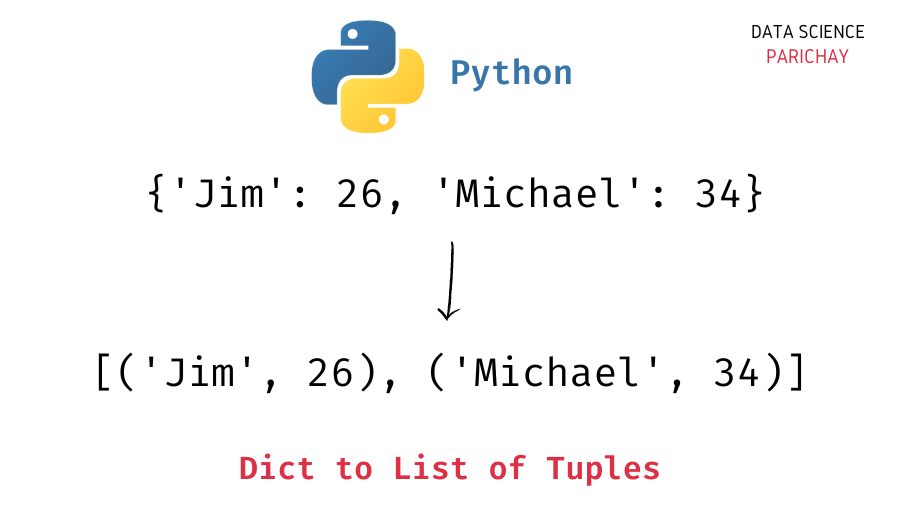
There are multiple ways to get a list of (key, value) tuple pairs from a dictionary. Some of which are –
- You can use the dictionary’s
.items()function and thelist()function. - Use a loop to iterate over the dictionary items and add the (key, value) tuple pairs to a list.
- Using list comprehension to construct the list of (key, value) tuple pairs.
Let’s look at examples of using the above methods to get a list of tuples from a dictionary.
Using items() and list() function
You can use a combination of the dictionary items() function and the list() function to convert a dictionary to a list of (key, value) tuples.
# create a dictionary
age_dict = {'Sam': 26, 'Emma': 21, 'Varun': 29, 'Zayn': 24}
# dictionary to list of tuples
age_ls = list(age_dict.items())
print(age_ls)
Output:
[('Sam', 26), ('Emma', 21), ('Varun', 29), ('Zayn', 24)]
We get the desired list of (key, value) tuple pairs. The dictionary items() function returns a view object containing the (key, value) tuple pairs, and the list() function converts the view object to a list.
Iterate over the dictionary items with a Loop
Here we use a loop to iterate over the items in the dictionary and then append the (key, value) tuple to our result list.
# create a dictionary
age_dict = {'Sam': 26, 'Emma': 21, 'Varun': 29, 'Zayn': 24}
# dictionary to list of tuples
age_ls = []
for key,val in age_dict.items():
    age_ls.append((key, val))
print(age_ls)
Output:
Introductory ⭐
- Harvard University Data Science: Learn R Basics for Data Science
- Standford University Data Science: Introduction to Machine Learning
- UC Davis Data Science: Learn SQL Basics for Data Science
- IBM Data Science: Professional Certificate in Data Science
- IBM Data Analysis: Professional Certificate in Data Analytics
- Google Data Analysis: Professional Certificate in Data Analytics
- IBM Data Science: Professional Certificate in Python Data Science
- IBM Data Engineering Fundamentals: Python Basics for Data Science
Intermediate ⭐⭐⭐
- Harvard University Learning Python for Data Science: Introduction to Data Science with Python
- Harvard University Computer Science Courses: Using Python for Research
- IBM Python Data Science: Visualizing Data with Python
- DeepLearning.AI Data Science and Machine Learning: Deep Learning Specialization
Advanced ⭐⭐⭐⭐⭐
- UC San Diego Data Science: Python for Data Science
- UC San Diego Data Science: Probability and Statistics in Data Science using Python
- Google Data Analysis: Professional Certificate in Advanced Data Analytics
- MIT Statistics and Data Science: Machine Learning with Python - from Linear Models to Deep Learning
- MIT Statistics and Data Science: MicroMasters® Program in Statistics and Data Science
🔎 Find Data Science Programs 👨💻 111,889 already enrolled
Disclaimer: Data Science Parichay is reader supported. When you purchase a course through a link on this site, we may earn a small commission at no additional cost to you. Earned commissions help support this website and its team of writers.
[('Sam', 26), ('Emma', 21), ('Varun', 29), ('Zayn', 24)]
We get the same result as above.
Using List Comprehension
The above method can be reduced to a single line using list comprehension.
# create a dictionary
age_dict = {'Sam': 26, 'Emma': 21, 'Varun': 29, 'Zayn': 24}
# dictionary to list of tuples
age_ls = [(key, val) for key,val in age_dict.items()]
print(age_ls)
Output:
[('Sam', 26), ('Emma', 21), ('Varun', 29), ('Zayn', 24)]
We get the same results as above. Here, we use list comprehension to build a list of (key, value) tuple pairs from the dictionary’s items.
You might also be interested in –
Subscribe to our newsletter for more informative guides and tutorials.
We do not spam and you can opt out any time.